ALKALAI FINANCIAL GROUP
  • Home
  • Services
    • Wealth Creation
    • Social Security Benefits
    • P&C
    • Why I3P?
  • About
    • Blog
  • Want To Chat?

Retirement Thoughts!

Wall street rule of 100

9/10/2020

0 Comments

 
Your advisor may have his or her own suggestions or methods to determine proper allocations to instruments on the risk vs. reward pyramid.

One method that you might hear about or read about is commonly referred to as 

​The Wall Street Rule of 100.

While there are many reasons this “rule” has proven to be popular, a compelling one is its simplicity.  
Picture
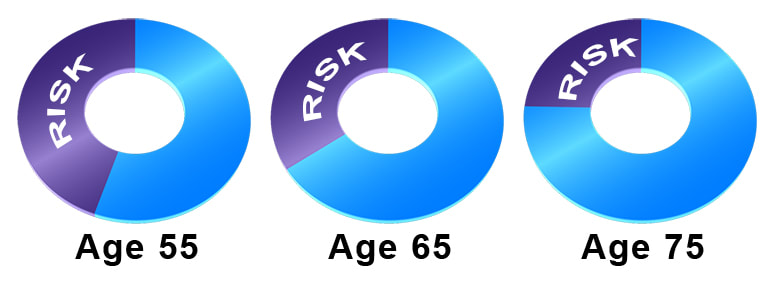
This rule dictates that the percentage of a person’s savings that is invested in equities should always equal 100-minus the person’s age.

For example, a person who is age 55 should limit his percentage of stock market type investments to 45 percent of the total.

At age 65, the portion invested in the stock market or items in a similar position on the risk vs. reward pyramid should be reduced to 35 percent of the total.

And at age 75, there should be no more than 25 percent invested in stocks, mutual funds and the like.

No allocation strategy is perfect, and there are those who criticize the 100-minus age rule as being far too simplistic, but generally speaking, the concept of reducing risk of investment losses as a person ages is sound.

The reason, in part, is because as a person ages he or she may have less time to ride out the inevitable downturns in the stock market.


Some advisors suggest that instead of 100-minus age, the rule should be modified so that it is 110 or some other higher number minus age.

This would result in a larger allocation of the portfolio to equities and other instruments higher up on the risk vs. reward pyramid.

The logic behind this position centers on the fact that today, people are living longer than they were when people first started using this allocation method, so the formula needs to be adjusted.

There may be equally valid reasons for reducing the allocation to instruments at risk of investment loss if a person can’t tolerate volatility.

A person should not feel compelled to use any specific allocation just because some rule or tactic says it is appropriate.

The percentages used in any person’s actual retirement plan should be adjusted up or down based on individual circumstances and as accurate an assessment of a person’s true risk tolerance as is possible.

For purposes of the discussion that follows, we will assume that a person and her advisor believe it is appropriate to follow the 100-minus age rule without any modification or adjustment. 

Few things will be more important than your future retirement. And the way time flies, it will happen before you know it.  We can help you plan for the inevitable. ​


0 Comments

Your comment will be posted after it is approved.


Leave a Reply.

    View my profile on LinkedIn

    Archives

    March 2023
    February 2023
    December 2021
    March 2021
    February 2021
    January 2021
    December 2020
    November 2020
    October 2020
    September 2020
    August 2020

    Categories

    All

    RSS Feed

Services

Wealth Creation
Auto|Home|Business

Support

Contact
© COPYRIGHT 2019. ALL RIGHTS RESERVED.
  • Home
  • Services
    • Wealth Creation
    • Social Security Benefits
    • P&C
    • Why I3P?
  • About
    • Blog
  • Want To Chat?