ALKALAI FINANCIAL GROUP
  • Home
  • Services
    • Wealth Creation
    • Social Security Benefits
    • P&C
    • Why I3P?
  • About
    • Blog
  • Want To Chat?

Retirement Thoughts!

why you should not hate annuities!

9/24/2020

0 Comments

 
Other than Social Security or employer-provided pensions, annuities are the only financial instrument with the specific purpose of providing lifelong income.

But before going further, it will be important to better define the type of annuity that will be discussed in this chapter for that purpose.

There are many types of annuities, each designed with their own specific features and benefits.

But generally speaking, all annuities can be placed in one of two different categories that are important to understand.

There are fixed annuities and variable annuities.

With fixed annuities, your money is never invested in stocks, mutual funds or instruments that have a risk of investment loss.

The potential growth in the annuity is based on the crediting of an interest rate.

​The way that this interest rate is determined can vary widely between one fixed annuity and another.
​
Variable annuities, on the other hand, provide the owner with options as to how the money is invested.

Generally speaking, most variable annuities provide several choices that allow for all or a portion of the money to be invested in things that are very similar to stock market-type mutual funds that have a risk of investment losses. 
Picture
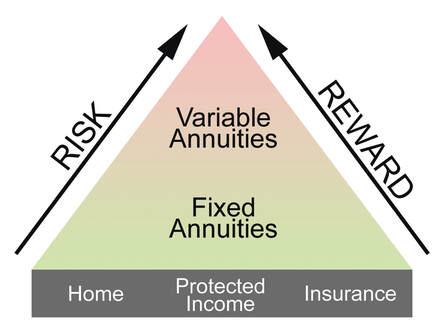
Referring again to the risk vs. reward pyramid, it is appropriate to say that you would find fixed annuities located lower down on the pyramid because they provide protection against investment losses.

But you would also find them here because their reward, in terms of their growth potential, is also less.

On the other hand, we would expect to find variable annuities much higher on the risk vs. reward pyramid, because they can be at greater risk of investment losses, but their reward in terms of their growth potential is higher as well.

Each of these two basic forms of annuities can play a role in a person’s retirement planning, but it is important to realize that their role will likely be different.

If we think of this in terms of the 100-minus age rule, or any method used to allocate a person’s retirement savings between instruments that are protected from investment loss and instruments that are at risk of investment loss, it can be said that it might be appropriate to use variable annuities for the at risk portion of the overall portfolio and fixed annuities for the protected portion of the portfolio.

When an annuity is intended to be used to create a reliable, consistent, lifelong income, it might be better to consider a fixed annuity.

The reason is that while variable annuities might have greater upside potential, their exposure to investment losses can undermine the reliability of their income.

As you will see, the recommendations throughout this book are primarily to use a fixed annuity to provide just enough income to meet your basic essential living expenses.

Once you know that your basic minimum income needs are met, you have more freedom to use securities, variable annuities or any other instrument you like to provide additional income.

It is also important to understand that, generally speaking, there are two basic categories of fixed annuities.

Few things will be more important than your future retirement. And the way time flies, it will happen before you know it.  We can help you plan for the inevitable. ​


0 Comments

Your comment will be posted after it is approved.


Leave a Reply.

    View my profile on LinkedIn

    Archives

    March 2023
    February 2023
    December 2021
    March 2021
    February 2021
    January 2021
    December 2020
    November 2020
    October 2020
    September 2020
    August 2020

    Categories

    All

    RSS Feed

Services

Wealth Creation
Auto|Home|Business

Support

Contact
© COPYRIGHT 2019. ALL RIGHTS RESERVED.
  • Home
  • Services
    • Wealth Creation
    • Social Security Benefits
    • P&C
    • Why I3P?
  • About
    • Blog
  • Want To Chat?